
Close Menu
    Facebook X (Twitter) Instagram
    SciTechDaily
    • Biology
    • Chemistry
    • Earth
    • Health
    • Physics
    • Science
    • Space
    • Technology
    Facebook X (Twitter) Pinterest YouTube RSS
    SciTechDaily
    Home»Space»This Tiny Blue Galaxy Is Glowing With Rare and Violent Stars
    Space

    This Tiny Blue Galaxy Is Glowing With Rare and Violent Stars

    By ESA/HubbleFebruary 12, 20261 Comment2 Mins Read
    Facebook Twitter Pinterest Telegram LinkedIn WhatsApp Email Reddit
    Share
    Facebook Twitter LinkedIn Pinterest Telegram Email Reddit
    Markarian 178 (Mrk 178) Hubble
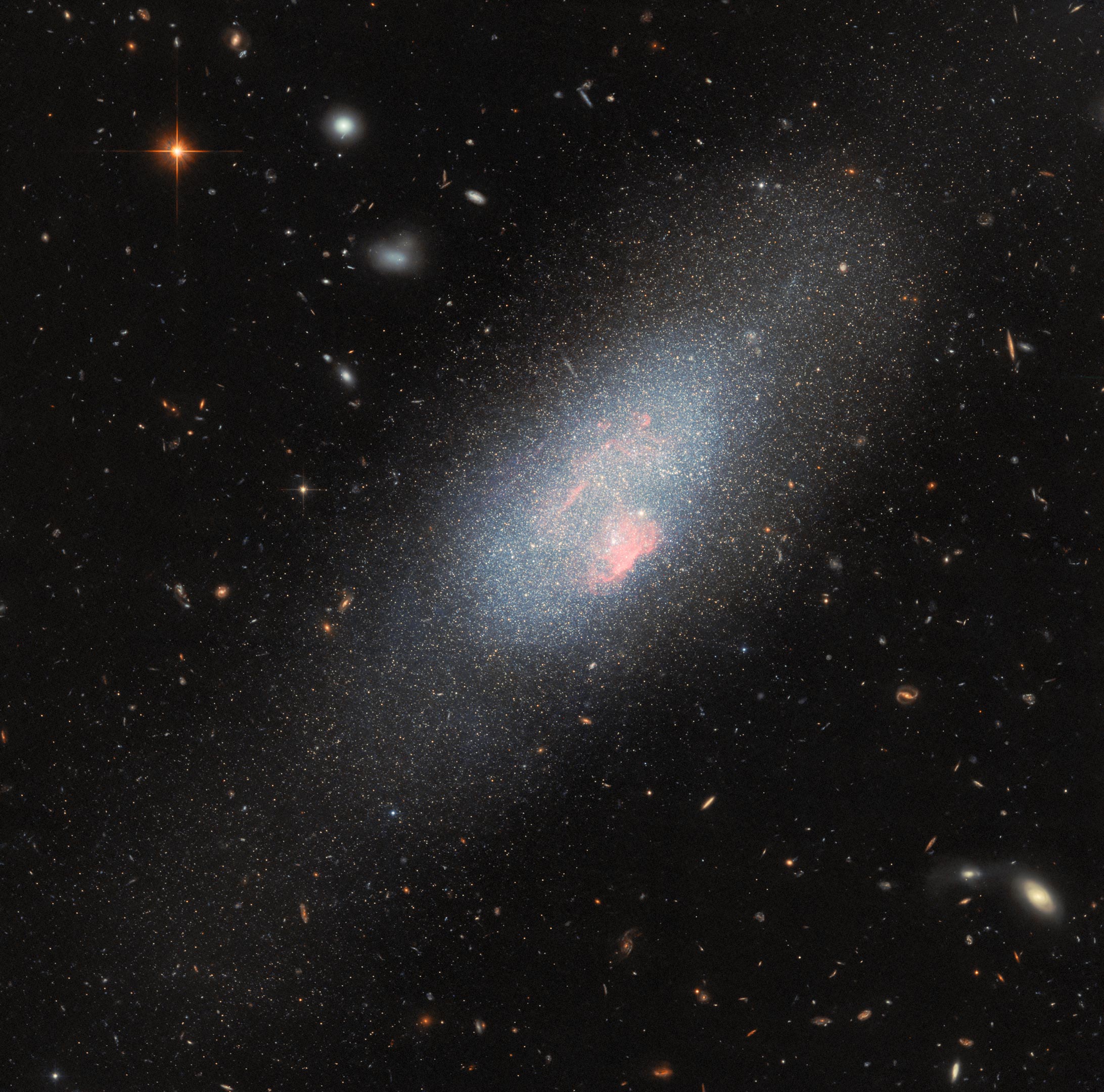
    A shimmering blue dwarf galaxy called Markarian 178 glows just 13 million light-years away, packed with hot young stars and rare stellar heavyweights. Credit: ESA/Hubble & NASA, F. Annibali, S. Hong

    A tiny blue galaxy packed with doomed giant stars hints at a recent, mysterious cosmic collision.

    The sparkling blue object featured as this ESA Hubble Picture of the Week is a compact dwarf galaxy known as Markarian 178 (Mrk 178). Much smaller than the Milky Way, this galaxy sits about 13 million light-years from Earth in the constellation Ursa Major (The Great Bear).

    Markarian 178 belongs to a larger family of more than 1500 Markarian galaxies. These systems were cataloged by Armenian astrophysicist Benjamin Markarian, who identified galaxies that stood out for their unusually strong ultraviolet light.

    Why Markarian 178 Shines Blue and Red

    Most of Markarian 178 glows blue because it is filled with young, extremely hot stars that are not heavily obscured by dust. However, parts of the galaxy also appear red due to a dense concentration of massive stars clustered near its brightest outer region. This vivid cloud hosts a remarkable number of rare Wolf–Rayet stars.

    Wolf–Rayet stars are massive stars that are rapidly shedding their outer layers through intense stellar winds. In Markarian 178, these winds produce strong emission signatures that are clearly visible in the galaxy’s spectrum. When viewed through specialized Hubble filters, glowing ionized hydrogen and oxygen show up as red tones, adding contrast to the galaxy’s dominant blue color.

    Clues to a Recent Burst of Star Formation

    Stars enter the Wolf–Rayet stage shortly before collapsing into black holes or neutron stars. Since this phase lasts only a few million years, the abundance of Wolf–Rayet stars in Markarian 178 indicates that the galaxy experienced a recent surge in star formation.

    The cause of this activity is not immediately obvious. Markarian 178 appears relatively isolated, with no large nearby galaxies that could have easily disturbed its gas. Astronomers think the trigger was an encounter with a much smaller companion galaxy. Deep observations from the Large Binocular Telescope revealed faint tidal structures surrounding Mrk178, suggesting a past interaction. Upcoming high-resolution Hubble observations will be key to uncovering the full star formation history of this energetic dwarf galaxy.

    Never miss a breakthrough: Join the SciTechDaily newsletter.
    Follow us on Google and Google News.

    Astronomy European Space Agency Hubble Space Telescope
    Share. Facebook Twitter Pinterest LinkedIn Email Reddit

    Related Articles

    A Diamond Necklace of Cosmic Proportions

    Hubble Snaps a Stunning Close-Up of a Magnificent Spiral Galaxy

    Extraordinary Hubble Image: Light Bends From the Beyond

    Hubble Space Telescope Sees Volcanic Activity Reforming the Atmosphere on a Rocky Exoplanet

    Hubble Spies a Luminous Heart With Dark Tendrils

    Spectacular Return to the Veil Nebula

    Hubble Spots a Peculiar Sight: Unusual Spiral Galaxy With a Heavy Arm

    A Flash of Life: Hubble Spies an Unusual Planetary Nebula

    Through the Cosmic Clouds: Hubble Spots a Beautiful Stellar Nursery

    1 Comment

    1. kamir bouchareb st on February 13, 2026 4:06 am

      This Tiny Blue Galaxy Is Glowing With Rare and Violent Stars
      good article

      Reply
    Leave A Reply Cancel Reply

    • Facebook
    • Twitter
    • Pinterest
    • YouTube

    Don't Miss a Discovery

    Subscribe for the Latest in Science & Tech!

    Trending News

    Popular Weight-Loss Drugs Like Ozempic Linked to Lower Breast Cancer Risk

    AI Learned the Rules of the Universe and That Became a Problem

    Scientists Found a Hidden Brain Signal That Predicts Social Behavior

    Even GPT-5 Failed This Human Attention Test

    Scientists Discover a Biological Clock Unlike Anything Seen Before

    The Brain May Not Need Full Sleep To Recover, New Research Finds

    Your Gut Microbes May Decide How Many Calories You Really Absorb

    Millions Take This Joint Supplement but Scientists Found a Concerning Alzheimer’s Link

    Follow SciTechDaily
    • Facebook
    • Twitter
    • YouTube
    • Pinterest
    • Newsletter
    • RSS
    SciTech News
    • Biology News
    • Chemistry News
    • Earth News
    • Health News
    • Physics News
    • Science News
    • Space News
    • Technology News
    Recent Posts
    • Climate Models May Be Wrong About How Trees Store Carbon
    • Scientists Discovered a Fly That Sheds Its Wings and Sacrifices Its Sight
    • Researchers Capture the First Atomic-Level Images of a Critical Human DNA Repair Enzyme
    • Scientists Just Discovered a Cellular Survival System That Was Never Supposed To Exist
    • Scientists Discover Brain-Protecting Peptide That Could Change Parkinson’s Treatment
    Copyright © 1998 - 2026 SciTechDaily. All Rights Reserved.
    • Science News
    • About
    • Contact
    • Editorial Board
    • Privacy Policy
    • Terms of Use

    Type above and press Enter to search. Press Esc to cancel.